

Why Is Pressing Comb Brass Popular for Afro Hair Straightening?
2026-11-02
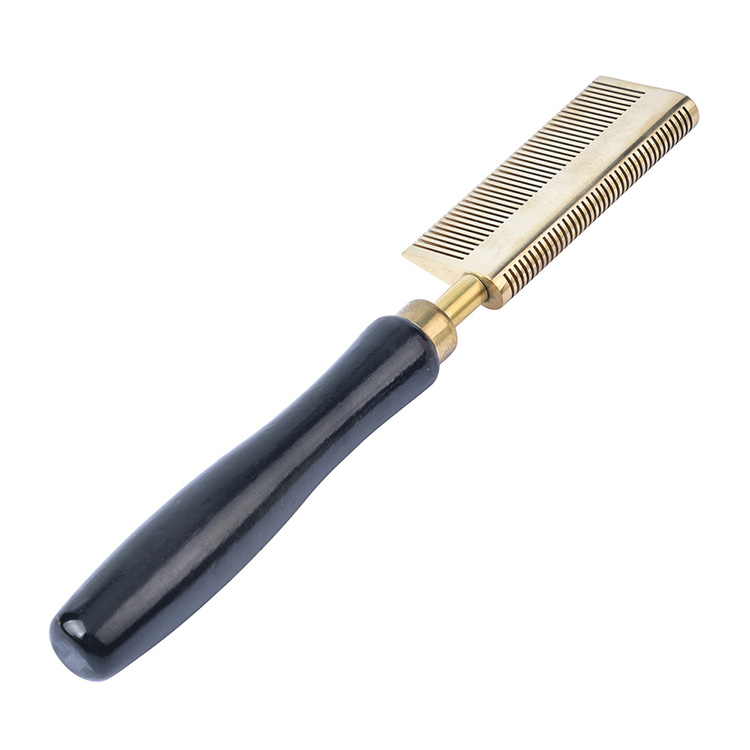
A stylist works on a client with tightly coiled type 4 hair. The client wants a sleek press that lasts through the week. The stylist has tried ceramic flat irons and titanium plates, but the results are inconsistent. The hair reverts within hours, and the ends show heat damage. The stylist switches to a Pressing Comb Brass and the result changes. The comb glides through the section, the heat penetrates the coil, and the press holds. The difference is not a marketing claim. It is the thermal behavior of the brass, the geometry of the teeth, and the way the comb is temperature controlled. This guide explains why the brass pressing comb is popular for Afro hair straightening.
1. Why Does Afro Hair Demand a Different Heat Tool Than Other Hair Types?
Afro textured hair has an elliptical cross section, a tighter curl pattern, and fewer cuticle layers than straight hair. The sebum from the scalp does not travel easily along the shaft, so the hair is naturally drier. The curl pattern is set by disulfide bonds and hydrogen bonds. To straighten the hair, the heat must break the hydrogen bonds and the mechanical action must rearrange them. The heat must penetrate the full thickness of the section, not just the surface. A flat iron applies heat from two flat plates, but the plates compress the section and the heat reaches the surface quickly while the core remains cooler. A comb applies heat from multiple teeth that separate the section into smaller strands, so the heat reaches the core more evenly. In our factory, we manufacture Pressing Comb Brass units for professional and retail use. Ningbo Ruishi Technology Co., Ltd. has been manufacturing hair tools for over 10 years.
The Afro hair also has a higher breakage risk when it is dry and when it is manipulated at high temperature. The comb must glide without snagging, and the temperature must be controlled so that the hair does not reach the temperature at which the keratin denatures. The brass comb is designed around these two requirements.
2. What Does Brass Actually Do Differently From Ceramic and Aluminum?
Brass has a thermal conductivity of about 109 W/mK, which is higher than ceramic at 2 to 30 W/mK and higher than aluminum at 205 W/mK in absolute terms but with a different thermal mass. The key difference is the combination of conductivity and heat capacity. Brass has a high volumetric heat capacity, so the comb holds its temperature when it contacts the hair. A ceramic plate has a lower heat capacity, so it cools at the contact point and the stylist must slow down. The brass comb recovers its temperature quickly because the heater can supply heat to the mass. The table below compares the thermal properties of brass, ceramic, aluminum, and titanium.
| Material | Thermal conductivity (W/mK) | Volumetric heat capacity (J/cm³K) | Temperature recovery | Surface durability |
| Brass | 109 | 3.4 | Fast | Good (can be polished) |
| Ceramic | 2 – 30 | 2.5 – 3.0 | Slow | Excellent (scratch resistant) |
| Aluminum | 205 | 2.4 | Fast | Moderate (soft, can dent) |
| Titanium | 22 | 2.4 | Moderate | Excellent (corrosion resistant) |
In our factory, we use a lead-free brass alloy for the comb body. The alloy is selected for thermal conductivity and for machinability. We machine the teeth and the spine from a single billet, so there is no joint that can loosen at high temperature. Ningbo Ruishi Technology Co., Ltd. provides the material certificate with the alloy composition for each batch.
3. How Does the Comb Tooth Geometry Affect Straightening Efficiency and Breakage?
The tooth geometry determines how the comb separates the hair, how the heat reaches the core, and how much tension is applied. The tooth pitch, which is the distance between the teeth, determines the size of the strand. A smaller pitch separates the hair into finer strands, which straightens faster but requires more passes. A larger pitch separates the hair into coarser strands, which requires more heat and more passes. The tooth depth determines how deep the hair sits in the comb. A deeper tooth holds more hair and applies more tension. The tooth tip radius determines the friction. A sharp tip catches the hair and causes breakage. A rounded tip glides. The table below shows the recommended tooth geometry for different hair types.
| Hair type | Recommended tooth pitch | Recommended tooth depth | Tip radius | Breakage risk |
| Fine to medium | 2.5 – 3.0 mm | 15 – 18 mm | 0.3 mm | Low |
| Medium to thick | 3.0 – 3.5 mm | 18 – 22 mm | 0.4 mm | Low to moderate |
| Coarse and tightly coiled | 3.5 – 4.0 mm | 22 – 25 mm | 0.5 mm | Moderate |
| Transitioning or damaged | 2.0 – 2.5 mm | 12 – 15 mm | 0.6 mm | Low |
Hair tool engineer's note: The tooth tip radius is the single most important factor for breakage. A sharp tip creates a stress concentration where the hair bends around the tooth. A rounded tip distributes the stress. In our factory, we polish the tooth tips to a radius of 0.3 to 0.6 mm and we inspect the tips under a magnifier. Ningbo Ruishi Technology Co., Ltd. provides the tip radius specification with each comb model.
4. Why Do Heat-Up Rate and Temperature Control Decide Whether the Comb Is Safe on Treated Hair?
The temperature control determines whether the comb straightens the hair without damaging it. The keratin in the hair denatures at about 180 to 200 degrees Celsius when the hair is dry. A comb that overshoots the setpoint can reach this temperature at the tooth surface and cause permanent damage. A comb that heats too slowly frustrates the stylist and produces uneven results. The heat-up rate and the temperature stability depend on the heater power, the thermal mass of the brass, and the control algorithm. In our factory, we test the heat-up curve and the temperature stability of every comb model. The comb must reach the setpoint within 3 minutes and maintain it within plus or minus 5 degrees Celsius during a 10 minute press. We also test the temperature recovery after contact with a wet or damp strand. Ningbo Ruishi Technology Co., Ltd. provides the temperature test report with each production lot.
The temperature control is especially important for hair that has been chemically treated. Relaxed or color-treated hair has a weaker cuticle and a lower denaturation temperature. The comb should be used at a lower setpoint for these hair types, and the control must be accurate enough to hold the lower setpoint without overshoot.
5. How Should Buyers Specify and Verify a Brass Pressing Comb for Afro Hair?
The specification should include six items. The first is the brass alloy and the lead content. The second is the tooth pitch and the tooth depth. The third is the tooth tip radius. The fourth is the working temperature range and the temperature stability. The fifth is the heat-up time. The sixth is the handle material and the thermal insulation. The verification should include four tests. The first is the heat-up curve measurement. The second is the temperature stability test at the setpoint. The third is the tooth tip radius inspection. The fourth is a continuous operation test for 30 minutes to verify that the handle does not overheat. In our factory, we perform these tests on every production lot and provide the test report with the shipment. Ningbo Ruishi Technology Co., Ltd. also offers a sample for the buyer to evaluate on the target hair type.
We recommend that the buyer specify the lead content as less than 0.05 percent, in line with the restrictions in major markets. A brass comb that contains lead can release lead when it is heated and can pose a health risk. The buyer should request the material certificate and verify the lead content before placing a large order.
Frequently Asked Questions About Brass Pressing Combs for Afro Hair
Summary for Stylists and Tool Buyers
The brass pressing comb is popular for Afro hair straightening because brass combines high thermal conductivity with high heat capacity, so the comb delivers heat to the core of the hair section without cooling at the contact point. The tooth geometry determines the strand size, the tension, and the breakage risk. The temperature control determines whether the comb straightens the hair without damaging the keratin. The specification should include the brass alloy and lead content, the tooth pitch and depth, the tip radius, the temperature range and stability, and the heat-up time. The verification should include the heat-up curve, the temperature stability test, the tip radius inspection, and the continuous operation test. Ningbo Ruishi Technology Co., Ltd. has been manufacturing hair tools for over 10 years and provides full material and temperature test support for our customers.