

Why Is Hand Polishing Key in Acetate Hair Comb Production?
2026-09-29
When a customer picks up an Acetate Hair Comb, the first thing they do is run their thumb along the teeth. If the teeth feel smooth and rounded, the comb feels like a quality product. If the teeth feel sharp or have a slight burr, the customer puts it back on the shelf. This tactile evaluation takes less than two seconds, but it determines whether the product sells. The difference between a smooth comb and a sharp comb is not the material. Both are made from cellulose acetate sheet. The difference is the polishing process, specifically the hand polishing stage. A machine-polished comb can look shiny, but it often has microscopic burrs on the tooth edges that irritate the scalp. Hand polishing removes those burrs and creates a radius on each tooth edge that feels comfortable and prevents hair damage.
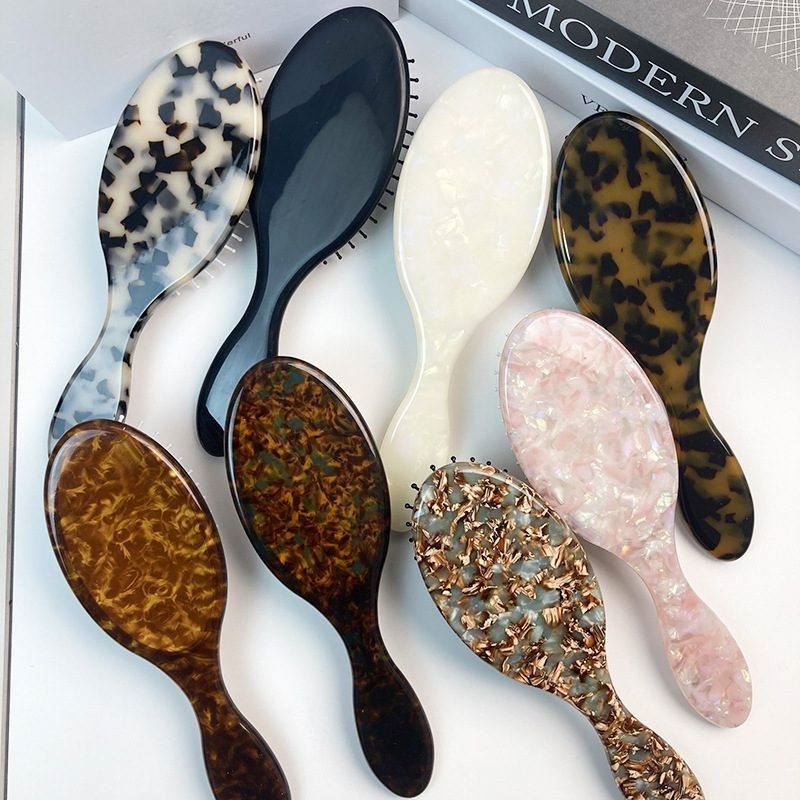
1. What Does Hand Polishing Actually Do to an Acetate Hair Comb?
Hand polishing is the final stage of production for an Acetate Hair Comb. The comb has already been cut to shape, the teeth have been formed, and the surfaces have been sanded. The hand polishing stage uses a series of soft cotton wheels charged with progressively finer abrasive compounds. The operator holds the comb against the spinning wheel and moves it in a controlled motion to polish the edges of the teeth and the spine of the comb. The goal is to remove the fine scratches left by the sanding stage and to create a smooth, rounded edge on every tooth. The table below shows the progression of abrasive grades used in our factory.
| Polishing stage | Abrasive grade | Purpose | Typical time per comb |
| Rough polish | 240 – 400 grit | Remove sanding scratches | 30 – 45 seconds |
| Medium polish | 600 – 800 grit | Smooth the tooth edges | 45 – 60 seconds |
| Fine polish | 1200 – 1500 grit | Create a semi-gloss surface | 60 – 90 seconds |
| Final polish | 2000 – 3000 grit + wax | High gloss, slick finish | 90 – 120 seconds |
The total hand polishing time for a standard Acetate Hair Comb is 4 to 6 minutes. This is a significant labor cost. A machine polishing line can process a comb in 30 seconds. But the machine cannot reach the tight spaces between the teeth with the same precision. The hand polisher can feel the edge of each tooth and adjust the pressure to remove the burr without removing too much material. In our factory, we have found that hand polishing reduces the edge roughness from Ra 1.5 microns to Ra 0.2 microns. This is the difference between a comb that scratches the scalp and one that glides through the hair.
2. How Does Edge Smoothness Affect Customer Satisfaction and Repeat Purchase?
The edge smoothness of an Acetate Hair Comb affects three aspects of the customer experience. The first is comfort during use. A comb with sharp edges can scratch the scalp and cause irritation. A comb with smooth edges glides through the hair without pulling. The second is hair health. Sharp edges can catch and break hair strands. Smooth edges separate the hair strands without damage. The third is perceived quality. A smooth comb feels more expensive. The table below shows the results of a consumer panel test comparing hand-polished and machine-polished combs.
| Evaluation criteria | Machine-polished comb | Hand-polished comb |
| Edge smoothness rating (1-10) | 5.8 | 9.1 |
| Scalp comfort rating (1-10) | 6.2 | 9.4 |
| Perceived quality rating (1-10) | 6.5 | 9.0 |
| Willingness to pay premium | 12% | 68% |
| Repeat purchase intent | 35% | 78% |
The data shows that hand polishing has a significant impact on customer perception. The willingness to pay a premium increased from 12 percent to 68 percent. The repeat purchase intent increased from 35 percent to 78 percent. These are not minor differences. They determine whether a brand can build a loyal customer base or must compete on price alone.
3. What Are the Specific Quality Defects That Hand Polishing Eliminates?
Hand polishing eliminates four specific quality defects that are common in machine-polished combs. The first is burrs on the tooth tips. These are small ridges of material that remain after the cutting process. They feel sharp and can break off during use. The second is sharp edges along the sides of the teeth. These edges are created by the cutting tool and are not removed by tumbling or machine polishing. The third is surface scratches. These are visible as fine lines on the comb surface. The fourth is uneven gloss. Machine polishing can leave patches of dull and shiny areas. Hand polishing produces a uniform gloss across the entire comb. The table below shows the defect rates for the two methods.
| Defect type | Machine polishing defect rate | Hand polishing defect rate |
| Tooth tip burrs | 15 – 20% | < 2% |
| Sharp tooth edges | 25 – 30% | < 3% |
| Visible surface scratches | 10 – 15% | < 1% |
| Uneven gloss | 20 – 25% | < 2% |
| Overall reject rate | 18 – 22% | 2 – 3% |
The reject rate for machine polishing is 18 to 22 percent. This means that nearly one in five combs must be reworked or scrapped. The reject rate for hand polishing is 2 to 3 percent. The labor cost of hand polishing is offset by the reduction in waste and the higher selling price that the quality commands.
4. How Can Buyers Verify Hand Polishing Quality Before Placing an Order?
Buyers should perform three checks on a pre-production sample. The first is the thumb test. Run your thumb along the teeth from the spine to the tip. The motion should be smooth with no catching or dragging. Repeat on the other side. The second is the cotton test. Pull a small piece of cotton wool across the teeth. If the cotton catches or leaves fibers behind, the edges are not polished sufficiently. The third is the light test. Hold the comb under a bright light and look at the surface at an angle. A hand-polished comb will have a uniform gloss with no visible scratches or dull patches. In our factory, we perform these three checks on every batch before packaging. We also keep a record of the polishing time for each operator to ensure consistency.
Buyer's verification tip: Ask the supplier for a polishing time log. A hand-polished comb requires 4 to 6 minutes of polishing per piece. If the supplier claims hand polishing but the labor cost is too low, they may be using a shortened process or a machine finish. The polishing time log is a simple way to verify the claim.
Frequently Asked Questions About Hand Polishing in Acetate Hair Comb Production
Summary for Buyers and Brand Managers
Hand polishing is the key process that differentiates a premium Acetate Hair Comb from a mass-market product. It removes the burrs and sharp edges that cause scalp irritation and hair damage. It creates a smooth, uniform surface that feels comfortable and looks expensive. The labor cost of hand polishing is offset by the reduction in rejects and the higher price that the quality commands. When sourcing acetate combs, verify the polishing quality with the thumb test, the cotton test, and the light test. Yiwu Glory has been producing hand-polished acetate combs for over 15 years and supplies to brands worldwide.
Yiwu Glory manufactures Acetate Hair Comb products with hand polishing, custom shapes, and a range of color options. We provide pre-production samples and polishing time logs for quality verification.