Why Are DIY Lash Extension Kits Becoming an Option for At-Home Beauty Routines?
2026-10-29
A regular salon client cancels her lash appointment for the third time in two months. The salon is fully booked, the appointment takes two hours, and the refill is due every three weeks. She orders a DIY Lash Extension kit and applies the clusters at home in 25 minutes. The result is not identical to the salon set, but it is close enough for her daily routine. This is the shift that is driving the growth of at-home lash kits. The kits are not a replacement for professional extensions. They are an alternative for consumers who want control over time, cost, and frequency. This guide explains what makes a kit work and what to verify before buying or sourcing one.
1. Why Did Lash Extensions Move From the Salon Chair to the Bathroom Mirror?
The salon lash extension market has three structural constraints. The first is time. A full set takes 90 to 120 minutes, and a refill takes 45 to 60 minutes. The second is cost. A full set costs $120 to $250, and refills cost $50 to $100 every two to three weeks. The third is availability. Popular technicians are booked weeks in advance, and a cancellation or a reschedule disrupts the client's routine. The DIY Lash Extension kit addresses these constraints by moving the application to the consumer's home, where the time and the frequency are under the consumer's control. In our factory, we manufacture DIY lash kits for beauty brands and private label customers. Pingdu Sparkling Eyelashes Co.,Ltd. has been manufacturing eyelash products for over 10 years.
The shift is also driven by the improvement in the kit components. Early DIY kits used strip lashes that were difficult to place and looked unnatural. Current kits use segmented clusters that are applied under the natural lash line, which gives a more natural result and is more forgiving for a first-time user.
2. What Makes a DIY Kit Different From a Salon Set in Terms of Product Construction?
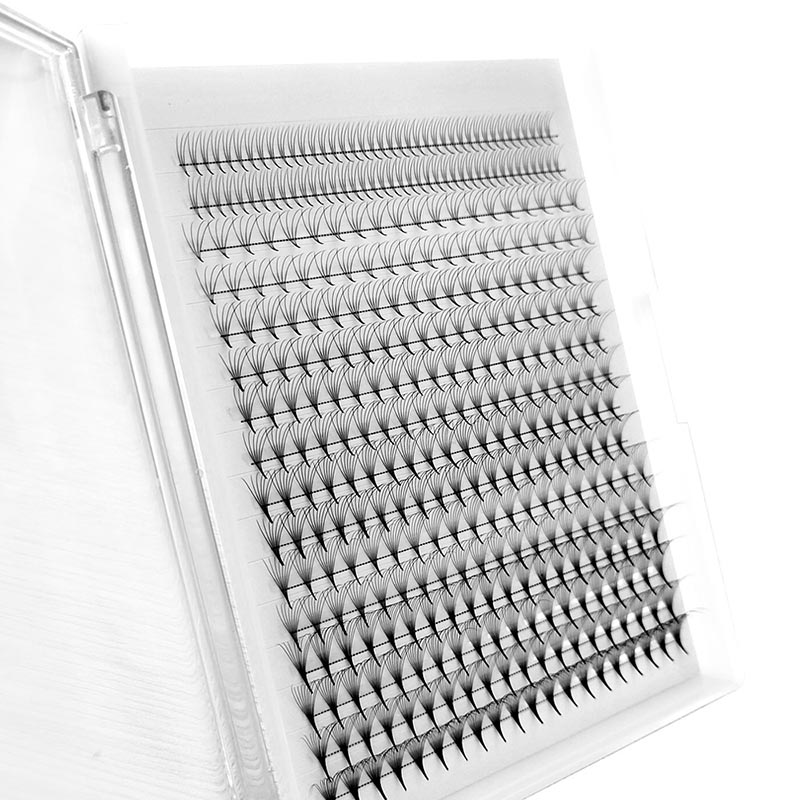
A DIY Lash Extension kit and a salon set differ in four areas: the lash format, the adhesive, the application tool, and the removal method. A salon set uses individual lashes that are isolated and bonded to a single natural lash with a professional adhesive. A DIY kit uses segmented clusters that are bonded to the underside of the natural lash line with a consumer-grade adhesive. The cluster format is faster to apply and does not require isolation of individual lashes. The table below compares the two formats.
| Feature | DIY Lash Extension kit | Salon lash set |
| Lash format | Segmented clusters (2 – 10 lashes per segment) | Individual lashes |
| Adhesive type | Consumer-grade, often cyanoacrylate-free or low-fume | Professional cyanoacrylate adhesive |
| Application time | 15 – 30 minutes | 90 – 120 minutes |
| Typical wear time | 3 – 7 days | 3 – 4 weeks |
| Removal method | Oil-based remover or remover gel | Professional remover |
| Skill requirement | Low to moderate | Certified technician |
In our factory, we produce clusters in lengths from 8 to 16 millimeters and in curl types from J to D. The clusters are made from synthetic fiber that is tapered to mimic the natural lash. We also supply the adhesive, the sealant, the applicator, and the remover as a complete kit. Sparkling provides private label packaging and formulation support for brands that want to launch a DIY line.
3. How Does the Learning Curve Affect Whether a First-Time User Continues?
The learning curve is the main reason a first-time user abandons the kit. The most common problems are misplacement, adhesion to the wrong lash, and asymmetry between the left and right eye. The segmented cluster format reduces these problems because the cluster is placed under the lash line rather than on a single lash, and the adhesive is applied to the cluster rather than to the natural lash. The user can place a cluster, check the position in a mirror, and adjust it before the adhesive sets. The table below shows the average application time and the satisfaction rating at different practice levels.
| Practice level | Average application time | Satisfaction rating (1 – 5) | Typical issue |
| First attempt | 35 – 45 minutes | 2.5 – 3.0 | Asymmetry, partial adhesion |
| Second attempt | 25 – 35 minutes | 3.2 – 3.8 | Cluster placement |
| Third attempt | 20 – 25 minutes | 3.8 – 4.3 | Minor alignment |
| Fourth attempt and beyond | 15 – 20 minutes | 4.3 – 4.7 | None |
Product developer's note: The satisfaction rating improves significantly after the third attempt. This means that the kit packaging should include a step-by-step guide and a link to a video tutorial. The first-time user who does not receive guidance is likely to abandon the kit after one attempt. In our factory, we provide a printed guide and a QR code that links to an application video with every DIY Lash Extension kit. Pingdu Sparkling Eyelashes Co.,Ltd. also offers a sample kit for brand testing before mass production.
4. Why Do Adhesive Formula and Removal Method Determine Safety for At-Home Use?
The adhesive is the component that carries the highest safety risk in a DIY kit. The professional adhesives used in salons contain cyanoacrylate, which can cause irritation if it contacts the skin or the eye. The consumer-grade adhesives used in DIY kits are formulated to be less volatile and less irritating. Some kits use a cyanoacrylate-free adhesive that cures more slowly but is gentler on the sensitive skin around the eye. The removal method is equally important. The adhesive must be removed with an oil-based remover or a remover gel that dissolves the bond without pulling the natural lashes. In our factory, we test the adhesive for stability over 12 months and for skin irritation on a panel of volunteers. Pingdu Sparkling Eyelashes Co.,Ltd. provides the safety data sheet and the irritation test report with every adhesive batch.
We also recommend that the kit include a patch test instruction. The user should apply a small amount of adhesive to the inner forearm and wait 24 hours before using the product on the eye. This simple step reduces the risk of an allergic reaction.
5. How Should Brands and Buyers Specify and Verify a DIY Lash Extension Kit?
The specification should include six items. The first is the lash material and the taper. The second is the curl type and the length assortment. The third is the adhesive type, the cure time, and the wear time. The fourth is the removal method and the remover formulation. The fifth is the component list, including the applicator, the sealant, and the guide. The sixth is the packaging format. The verification should include three tests. The first is the adhesive stability test at elevated temperature. The second is the cluster tensile test to verify that the cluster does not shed during application. The third is a consumer use test with at least 30 participants to measure the learning curve and the satisfaction rating. In our factory, we perform these tests for every new kit and provide the test report with the shipment. Pingdu Sparkling Eyelashes Co.,Ltd. offers a full kit development service from formulation to packaging.
Frequently Asked Questions About DIY Lash Extension Kits
Summary for Beauty Brands and Product Developers
DIY Lash Extension kits are becoming an option for at-home beauty routines because they remove the time, cost, and scheduling constraints of salon extensions. The segmented cluster format is easier to apply than individual lashes, and the learning curve is short enough that most users reach a satisfactory result by the third attempt. The adhesive and the removal method are the main safety considerations, and the kit must include a patch test instruction and a proper remover. The specification should cover the lash material, the curl and length assortment, the adhesive type, the removal method, and the component list. Pingdu Sparkling Eyelashes Co.,Ltd. has been manufacturing eyelash products for over 10 years and provides full kit development and verification support for beauty brands.