
Why Are Acetate Hair Claws Considered a Premium Alternative to Plastic Clips?
2026-09-18
1. What Are the Most Common Problems with Plastic Hair Clips in Retail?
Plastic hair clips dominate the low-price segment of the market because they are cheap to produce. But they generate a disproportionate share of customer complaints and returns. The three most common problems are tooth breakage, spring failure, and surface scratching. Tooth breakage occurs because the plastic is brittle. When the clip is dropped or subjected to stress, the teeth snap off. Spring failure occurs because the metal spring is often made from low-grade steel that corrodes or loses tension. Surface scratching occurs because the plastic is soft and easily marked. In our experience with retail buyers, a plastic hair clip has a return rate of 5 to 8 percent, which is significant for a low-margin product.
The table below compares the failure modes of plastic and acetate hair claws.
| Failure mode | Plastic hair clip | Acetate Hair Claw |
| Tooth breakage | Common (brittle material) | Rare (flexible, impact resistant) |
| Spring failure | Common (low-grade steel) | Rare (stainless steel spring) |
| Surface scratching | Common (soft plastic) | Rare (hard, polished surface) |
| Color fading | Common (surface printed) | Rare (color through the material) |
| Return rate (retail average) | 5 – 8% | 1 – 2% |
Yiwu Glory Garments & Accessories Co., Ltd. has been supplying hair accessories to retailers for over 12 years. Our factory produces Acetate Hair Claw units that address each of these failure modes. We use cellulose acetate sheet that is cut, polished, and assembled by hand. The result is a product that lasts for years, not weeks.
2. What Is Cellulose Acetate and Why Is It More Durable Than Plastic?
Cellulose acetate is a semi-synthetic polymer derived from renewable resources. It is produced by reacting cellulose (from cotton linters or wood pulp) with acetic acid. The resulting material is thermoplastic, which means it can be molded or cut into shape. Unlike petroleum-based plastics, acetate has a natural depth and luster that resembles horn or tortoiseshell. But the key difference for buyers is durability. Acetate has a higher impact strength and a higher modulus of elasticity than polystyrene or polypropylene. This means it resists breakage and retains its shape. It is also less prone to scratching because it is harder. The table below compares the mechanical properties of acetate and common plastics.
| Property | Cellulose acetate | Polystyrene (PS) | Polypropylene (PP) |
| Impact strength (kJ/m²) | 25 – 35 | 15 – 20 | 20 – 30 |
| Hardness (Rockwell R) | 85 – 105 | 70 – 90 | 60 – 80 |
| Flexural modulus (MPa) | 1,800 – 2,500 | 2,500 – 3,500 | 1,000 – 1,500 |
| Color depth | Through the material | Surface only | Surface only |
| UV resistance | Good | Poor | Moderate |
The higher impact strength means that an Acetate Hair Claw can survive a drop onto a hard floor without breaking. The higher hardness means that it resists the scratches that accumulate during normal handling. The color is integrated into the material, so it does not fade or chip. These properties justify the higher price point.
3. How Does Acetate Allow for Unique Designs and Color Effects?
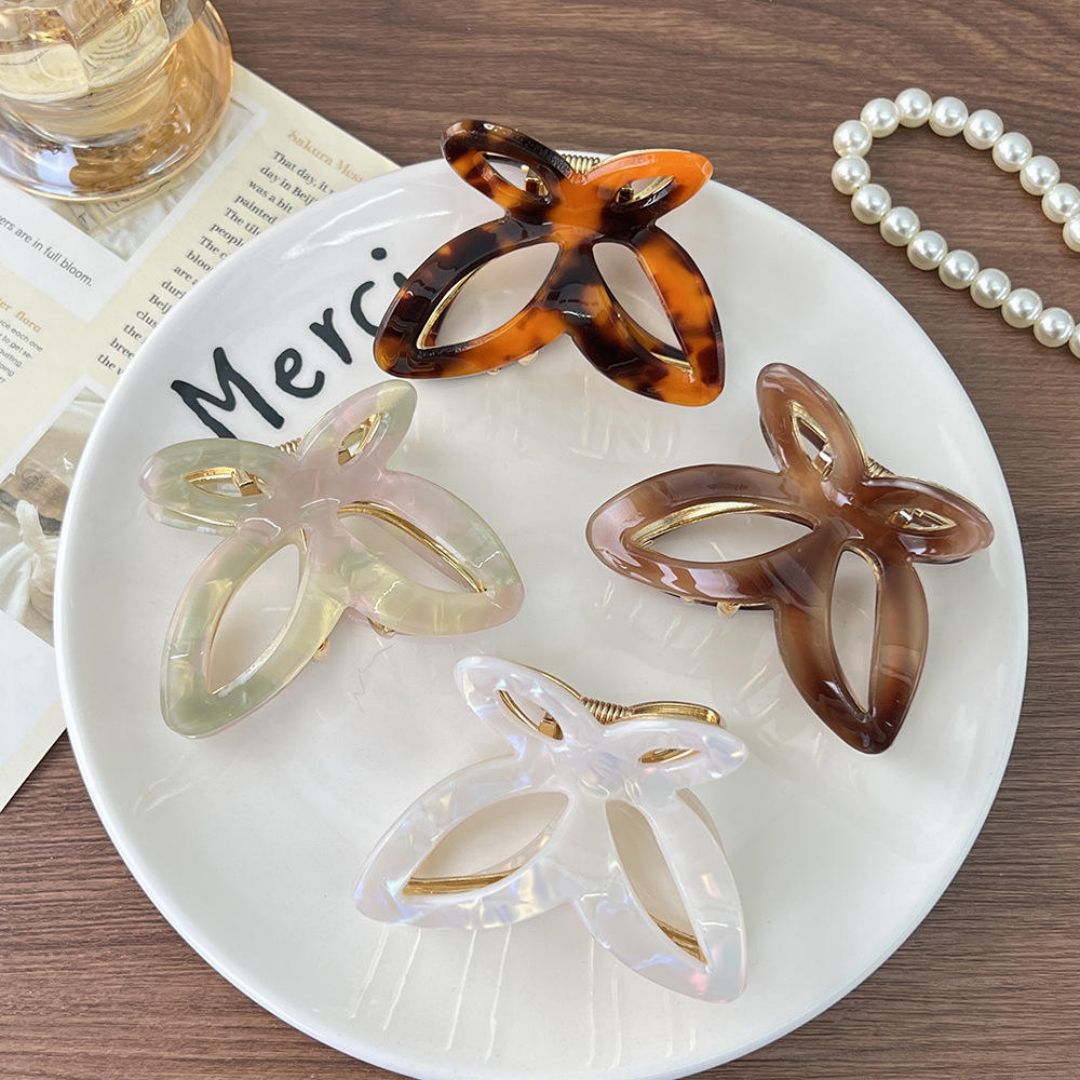
One of the commercial advantages of acetate is the range of visual effects that can be achieved. Because acetate is produced in sheets, multiple colors and patterns can be layered together before the sheet is cut into shape. This allows for effects that are impossible with injection-molded plastic. The most popular effects are tortoiseshell, marble, and crystal. A tortoiseshell Acetate Hair Claw has a depth and variation that a printed plastic clip cannot match. A marble effect is created by mixing two or more colors in the extrusion process. A crystal effect is achieved by adding a transparent dye to the acetate. The table below shows the design capabilities of acetate compared to plastic.
| Design effect | Acetate | Plastic (injection molded) |
| Tortoiseshell pattern | Yes (layered sheets) | No (only printed) |
| Marble effect | Yes (marbled sheet) | No |
| Transparent crystal | Yes | Limited (usually hazy) |
| Color gradient | Yes (layered) | No |
| Surface finish | High polish | Matte or semi-gloss |
Yiwu Glory Garments & Accessories Co., Ltd. produces Acetate Hair Claw units in a wide range of colors and patterns. Our factory has an in-house design team that can develop custom colorways for your brand. We also offer a range of surface finishes, from high polish to matte.
4. What Is the Commercial Case for Switching from Plastic to Acetate?
The commercial case is based on three factors: higher retail price, lower return rate, and stronger brand perception. A plastic hair clip typically retails for $2 to $5. An Acetate Hair Claw typically retails for $12 to $25. The cost of goods is higher for acetate, but the gross margin is also higher because the retail price is disproportionately higher. The lower return rate reduces the hidden cost of processing returns and issuing refunds. The stronger brand perception attracts customers who are willing to pay more for quality. In our experience, retailers who switch from plastic to acetate see a 20 to 40 percent increase in the average transaction value for hair accessories. They also see a reduction in customer complaints and a higher rate of repeat purchases.
Buyer's calculation example: A retailer sells 1,000 plastic clips per month at $3 each, with a 6 percent return rate. The net revenue is $2,820 after returns. If they switch to acetate claws at $15 each and sell 600 units per month with a 1.5 percent return rate, the net revenue is $8,865. Even though fewer units are sold, the revenue is more than three times higher.
Frequently Asked Questions About Acetate Hair Claws for Buyers
Summary for Fashion Buyers and Sourcing Managers
Acetate hair claws are considered a premium alternative to plastic clips because they solve the durability, color, and perception problems that plague low-cost plastic products. The material is derived from renewable resources, has higher impact strength and hardness, and allows for unique color effects. The commercial case is strong: higher retail price, lower return rate, and stronger brand perception. When sourcing acetate hair claws, verify the material, understand the minimum order quantities, and plan the packaging to support the premium positioning. Yiwu Glory Garments & Accessories Co., Ltd. has been supplying acetate hair accessories to retailers worldwide for over 12 years.
Yiwu Glory Garments & Accessories Co., Ltd. manufactures Acetate Hair Claw units in a wide range of colors, patterns, and finishes. We provide material certificates, custom design services, and retail packaging options.