
Gel Polish has moved far beyond being simply a long-wearing nail color. For nail salons, distributors, beauty brands, and OEM/ODM buyers, the real challenge is finding a gel polish system that delivers reliable application, attractive color performance, consistent curing, strong wear, practical removal, and scalable production. This guide explains the key areas that determine gel polish quality and helps buyers identify the details that matter before placing a bulk order.
What Gel Polish Actually Needs to Deliver
A successful Gel Polish product has to perform at several different stages. It must look attractive inside the bottle, apply smoothly to the nail, cure properly under a compatible lamp, maintain its appearance during wear, and be removable without unnecessary damage caused by aggressive techniques.
For consumers, these expectations may sound simple. For manufacturers and professional buyers, however, every expectation represents a technical requirement. Viscosity, pigment dispersion, curing behavior, adhesion, surface finish, bottle design, brush performance, packaging, and production consistency can all influence the customer experience.
This is especially important for wholesale buyers. A sample that performs well once is encouraging, but commercial success requires that the same characteristics remain consistent across larger production quantities, different shades, different batches, and the intended application environment.
Where Buyers Commonly Experience Problems
Many gel polish purchasing problems begin before production starts. Buyers may focus heavily on unit price or color selection while overlooking the technical specifications that influence repeat orders, customer satisfaction, and product returns.
Some formulas may appear too thick, too thin, streaky, or difficult to control, increasing application time for nail technicians.
Differences in pigmentation, layer thickness, lamp compatibility, or curing conditions can affect the final result.
A shade that changes between production batches can create problems for retailers, distributors, and repeat customers.
Other problems worth identifying early
- Color settling or poor pigment dispersion.
- Brushes that make precise application difficult.
- Bottles that are attractive but inconvenient to use.
- Unclear curing instructions.
- Weak adhesion caused by an incompatible overall system.
- Top coats that lose gloss too quickly.
- Packaging that does not match the target market.
- Limited customization for private-label brands.
- Large minimum order quantities that make market testing difficult.
- Insufficient communication during sample development.
Addressing these issues during product development is generally more efficient than trying to correct them after a large production run has already been completed.
How Formula Performance Affects the Final Result
The formula is at the heart of every Gel Polish product. A good formulation should balance flow, pigmentation, coverage, leveling, curing behavior, adhesion, finish, and removal requirements.
Viscosity and leveling
Viscosity affects how the product moves across the nail. If a formula is excessively thick, application may become difficult and the technician may struggle to create a thin, even layer. If it is too fluid, the product can move toward the surrounding skin before curing.
The ideal behavior depends on the product category and intended use. A highly pigmented color gel may need different flow characteristics from a translucent jelly shade or a liner gel.
Pigment dispersion
Consistent pigment dispersion is particularly important for commercial color collections. A beautiful shade should remain visually stable from bottle to bottle and should maintain the intended appearance after application.
Coverage
Coverage determines how many layers are required to achieve the desired appearance. Some customers prefer highly pigmented colors that provide strong coverage with minimal layers, while translucent collections intentionally create depth through multiple thin layers.
| Formula Characteristic | Why It Matters | Buyer Consideration |
|---|---|---|
| Viscosity | Influences control, leveling, and application speed. | Match the formula to the intended user and product category. |
| Pigmentation | Determines coverage, depth, and color intensity. | Evaluate actual nail swatches rather than bottle appearance alone. |
| Leveling | Helps create a smoother and more uniform surface. | Check whether the formula remains controllable during application. |
| Curing Behavior | Influences final hardness and product performance. | Confirm compatibility with the intended lamp and application system. |
| Removal Behavior | Affects professional service time and customer experience. | Confirm the intended removal method before commercial launch. |
How Color and Texture Influence Product Value
Color remains one of the strongest reasons customers purchase Gel Polish, but modern collections increasingly rely on texture and visual effects to create differentiation.
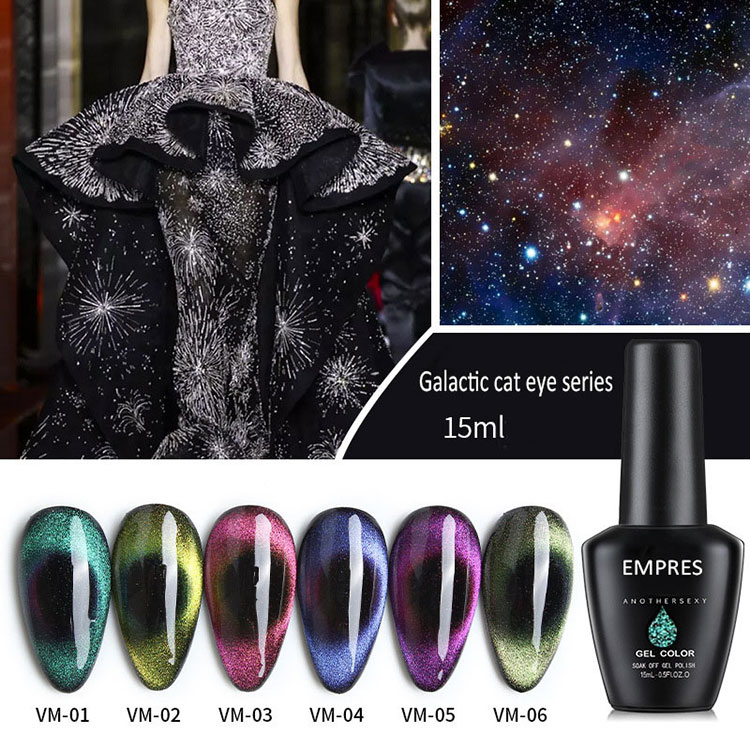
Traditional solid colors continue to provide a reliable foundation for a commercial collection. However, translucent jelly effects, cat-eye finishes, glitter, metallic effects, reflective finishes, blooming effects, liner gels, and color-changing concepts can help a brand build a more distinctive product portfolio.
Building a balanced color collection
- Core neutrals: nude, beige, pink, white, and soft brown shades can form the everyday foundation.
- Seasonal colors: fashion-oriented shades can support limited collections and seasonal promotions.
- Statement shades: stronger colors can attract customers seeking noticeable nail designs.
- Effect products: cat-eye, glitter, metallic, jelly, reflective, or magnetic effects can increase visual variety.
- Nail-art products: liner and specialized gels can support professional nail artists and detailed designs.
The most useful question for a buyer is not simply whether a color looks attractive. It is whether the shade contributes to a coherent product collection and whether its performance can be reproduced consistently at commercial scale.
Why Curing Compatibility Matters
Gel Polish is designed to cure through a light-activated process. This means the product and curing equipment should be considered together rather than independently.
Curing performance can be influenced by the product formulation, pigment concentration, layer thickness, lamp characteristics, exposure time, hand position, and other application variables. A high-powered lamp alone does not automatically guarantee that every gel formula will perform correctly.
Why darker colors may need special attention
Highly pigmented colors can behave differently from translucent shades because more pigment may affect how light travels through the applied layer. This is one reason professional testing should include multiple representative shades rather than relying only on a clear or pale sample.
Buyers should also evaluate whether instructions are clear enough for the final customer. Confusing curing information can create unnecessary complaints even when the underlying product is technically suitable.
How Application Quality Is Built Into the Product
Application is influenced not only by the technician's skill but also by product design. A well-designed Gel Polish should make it easier for the intended user to achieve a clean and consistent result.
- Natural nail preparation: The nail surface should be prepared according to the professional system being used.
- Controlled product amount: The brush should pick up a practical amount of product without excessive flooding.
- Thin and even application: Layers should remain controlled and appropriate for the formula.
- Clean edges: The product should be manageable around the cuticle and sidewall area.
- Complete curing: The manufacturer's recommended curing process should be followed.
- Final finish: The top coat should provide the intended gloss, matte, or special effect.
Product developers should therefore evaluate brush shape, bottle neck design, viscosity, self-leveling behavior, pigmentation, and curing characteristics together. These seemingly small details can have a substantial impact on the professional user's experience.
How to Improve Wear and Durability
Customers generally expect Gel Polish to maintain its color and finish during normal wear. However, durability is not created by a single ingredient or a single layer. It is influenced by the compatibility of the complete system and the way it is applied.
Important factors affecting wear
- Nail preparation: Excessive moisture, residue, oil, or unsuitable preparation can affect adhesion.
- Base compatibility: The base product should be appropriate for the intended color and nail system.
- Layer control: Excessively thick layers can create application and curing problems.
- Edge management: Clean application around the free edge can help reduce premature lifting.
- Curing: The complete system should follow the manufacturer's curing specifications.
- Top coat: The final layer should deliver the intended surface protection and appearance.
- Removal: Customers should avoid picking, peeling, or aggressively scraping the coating.
For professional buyers, durability testing should therefore be conducted using realistic application conditions rather than evaluating the color only inside the bottle.
What Bulk Buyers Should Check Before Ordering
Wholesale Gel Polish purchasing is fundamentally different from buying a few bottles for personal use. Commercial buyers need to think about consistency, documentation, packaging, production capacity, customization, logistics, and after-sales communication.
| Area | Questions to Ask |
|---|---|
| Formula | Is the formula suitable for the intended market and application method? |
| Color | Can the selected shades be reproduced consistently in larger production runs? |
| Packaging | Can bottle size, color, label, box, and other packaging elements be customized? |
| Samples | Can samples be tested before a larger order is confirmed? |
| Production | Can the supplier maintain stable production and quality requirements? |
| Documentation | Are appropriate product and safety documents available for the target market? |
| MOQ | Is the minimum order quantity realistic for the planned launch? |
| Customization | Can the manufacturer support OEM or ODM requirements? |
Why sample testing should come first
A sample gives buyers the opportunity to evaluate application, pigmentation, curing, brush performance, bottle usability, finish, and overall appearance before committing to a larger order.
For a new private-label collection, it is particularly useful to test several different shades rather than only one. A light nude, highly pigmented dark shade, glitter shade, and translucent effect product may reveal different performance characteristics.
How OEM and ODM Services Support Brand Growth
Private-label and customized Gel Polish programs allow beauty brands and distributors to develop products that match their own market positioning instead of selling a completely standardized product.
ShenZhen Colex Cosmetics Co.,Ltd. has been engaged in nail product manufacturing since 2012 and provides product categories covering Gel Polish, UV nail gel, nail polish, nail powder, removers, and related nail products. The company also provides OEM/ODM-related customization services for customers developing their own product lines.
For a brand owner, customization can involve much more than putting a logo on a bottle. A complete project may include shade development, product selection, bottle style, brush selection, labeling, packaging, collection planning, and other market-specific requirements.
When OEM/ODM becomes particularly useful
- Launching a new private-label nail brand.
- Creating a seasonal Gel Polish collection.
- Developing a specific color palette for a regional market.
- Refreshing existing packaging without completely changing the product concept.
- Building special-effect collections such as jelly, cat-eye, glitter, metallic, or reflective gel polish.
- Expanding from a small initial collection into a larger professional range.
The key is to define the target market and product requirements before development begins. Clear communication at the beginning can reduce unnecessary revisions later in the process.
A Practical Gel Polish Quality Checklist
Before approving a commercial Gel Polish order, buyers can use the following checklist to organize product evaluation.
- ☐ The color matches the approved reference sample.
- ☐ Pigmentation is consistent and suitable for the intended application.
- ☐ Viscosity allows controlled application.
- ☐ The product levels appropriately without becoming difficult to control.
- ☐ The brush supports accurate application.
- ☐ The bottle design is practical for the target market.
- ☐ Curing instructions are clearly provided.
- ☐ The product has been tested with the intended curing system.
- ☐ The final surface provides the expected finish.
- ☐ Wear performance has been evaluated under realistic conditions.
- ☐ Removal requirements are understood before launch.
- ☐ Packaging and labeling have been checked carefully.
- ☐ Relevant product documentation has been reviewed.
- ☐ Production samples have been approved before bulk manufacturing.
- ☐ MOQ, lead time, packaging requirements, and shipping details are clearly confirmed.
Gel Polish FAQ
Gel Polish is a nail coating designed to cure under a suitable light source. It combines decorative color with the characteristics of a cured gel system and is commonly used in professional salons, nail studios, beauty retail, and home-use nail applications.
Wear time varies according to the formulation, nail condition, preparation, application technique, curing system, lifestyle, and aftercare. Buyers should avoid promising one universal wear period and should instead test the product under the intended conditions.
Mixing products from different systems should not be assumed to be compatible. Base, color, top coat, and curing equipment can be designed around specific formulation characteristics. Professional testing and manufacturer guidance should be followed before combining products.
Wrinkling may be associated with factors such as excessive layer thickness, curing conditions, pigmentation, or incompatibility between the product and curing system. The manufacturer's application and curing instructions should be checked before changing the process.
The correct removal method depends on the specific product system. Some products are designed for soak-off removal, while others may require filing or a combination of procedures. Picking, peeling, or aggressive scraping should be avoided because these actions can damage the natural nail surface.
Yes. Depending on the manufacturer's capabilities, private-label projects may include customized colors, bottles, labels, packaging, product collections, and other OEM/ODM requirements. Buyers should discuss specifications, samples, MOQ, documentation, and production timelines before confirming the project.
At minimum, evaluate color accuracy, pigmentation, viscosity, brush performance, application, curing behavior, final finish, wear performance, removal behavior, packaging, and batch consistency. Testing several representative shades is more informative than testing only one color.
Look beyond the initial quotation. Consider product consistency, communication, sample development, customization capabilities, production capacity, documentation, quality management, packaging support, lead times, and after-sales service. A long-term supplier relationship depends on reliable execution as much as product price.
Ready to Develop Your Gel Polish Collection?
Whether you are a distributor, nail salon supplier, beauty brand, retailer, or private-label buyer, choosing the right Gel Polish manufacturing partner can make product development more efficient and predictable.
ShenZhen Colex Cosmetics Co.,Ltd. offers Gel Polish and related nail product manufacturing, together with OEM/ODM customization support. From everyday solid colors to special-effect collections, a well-planned product program can be developed around your target market, packaging requirements, and commercial goals.
If you are looking for Gel Polish samples, bulk pricing, customized packaging, private-label development, or product information, contact us to discuss your requirements and start your next nail product project.
Contact UsProduct specifications, application instructions, curing requirements, documentation, MOQ, and customization details should be confirmed with the manufacturer for each individual project and target market.