

How Much Hair Weft Is Needed for a Full-Head Extension Service?
2026-10-27
A client comes into a salon for a full-head extension. One stylist quotes three packs. Another stylist quotes five packs. The client asks why the difference. The answer is not a pricing tactic. It is the result of different assumptions about head circumference, natural hair density, and the desired end result. The amount of Hair Weft needed for a full-head service is not a fixed number. It is a calculation based on measurements and on the coverage the stylist intends to achieve. This guide explains how to perform that calculation so that the client receives the right amount of hair and the salon avoids both under-ordering and over-ordering.
1. Why Does the Required Amount of Hair Weft Depend on Head Measurements Rather Than a Fixed Number?
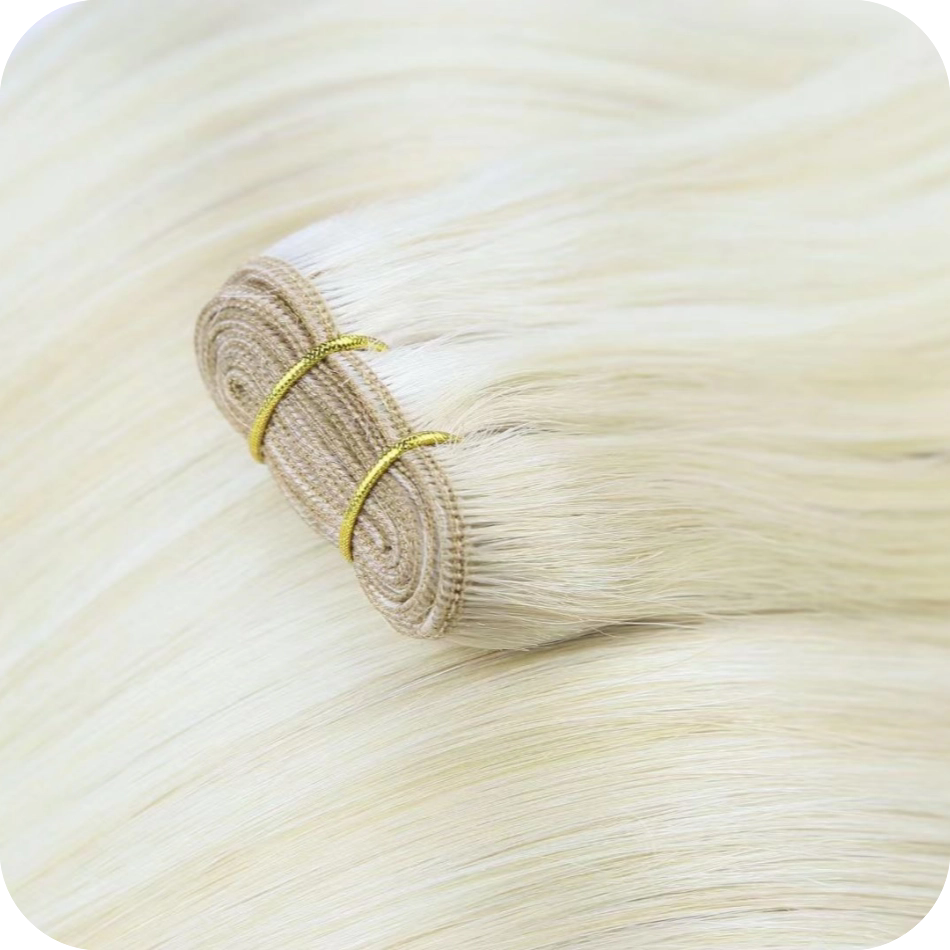
A full-head extension is not a single product. It is a system of individual Hair Weft rows that are installed across the scalp. The number of rows and the total weight depend on the distance from the front hairline to the nape, the width of the head at the crown, and the density of the natural hair. A client with a small head circumference and fine hair requires fewer rows than a client with a large head and thick hair, even if both want the same length. In our factory, we produce Hair Weft in standard widths and weights, and we provide a measurement guide so that the salon can calculate the required quantity before ordering. Qingdao Fly Lum Hair Factory has been manufacturing hair wefts for over 12 years.
The fixed-number approach leads to two problems. If the salon orders a fixed number and the client needs more, the installation is incomplete, and the client must return for a second appointment. If the salon orders a fixed number and the client needs less, the client pays for hair that is not used. A measurement-based approach avoids both problems.
2. How Do Head Circumference and Density Determine the Number of Weft Rows?
The number of rows is determined by the horizontal distance from the front hairline to the nape, measured over the crown. This distance is typically 30 to 38 centimeters for an adult. Each row of wefts covers a horizontal band of 4 to 6 centimeters, depending on the width of the weft and the installation method. The density of the natural hair determines how much of the band can be left uncovered without the natural hair showing through. A client with fine hair needs more rows to achieve a given volume than a client with thick hair. The table below shows the relationship between head measurements, density, and the number of rows and total weight for a full-head service.
| Head circumference | Natural hair density | Desired result | Recommended rows | Total weight |
| Small (52 – 54 cm) | Fine | Natural volume | 4 – 5 | 120 – 150 g |
| Small (52 – 54 cm) | Medium | Natural volume | 4 | 100 – 130 g |
| Medium (55 – 57 cm) | Medium | Natural volume | 5 – 6 | 140 – 180 g |
| Medium (55 – 57 cm) | Thick | Added volume | 5 | 130 – 170 g |
| Large (58 – 60 cm) | Thick | Added length and volume | 6 – 7 | 180 – 240 g |
The total weight is the sum of the weights of the individual wefts. The weight per weft depends on the width and the hair density of the weft itself. A standard weft of 100 centimeters width and 100 grams weight is a common reference. In our factory, we produce wefts in widths of 80, 100, and 120 centimeters and in weights of 80, 100, and 120 grams. Qingdao Fly Lum Hair Factory provides a weight and width specification sheet with each product.
3. What Happens to Coverage and Blend When the Hair Weft Is Under-Ordered?
Under-ordering is the most common cause of a failed full-head extension. The visible symptoms are predictable. The first is visible seams between the rows. When the rows are too far apart, the natural hair separates, and the weft attachment points become visible. The second is a lack of blend at the front hairline. When there is not enough hair to cover the transition, the extension looks like a separate layer rather than a natural part of the hair. The third is excessive tension on the natural hair. When fewer wefts carry the same total weight, each weft must support more hair, which increases the tension on the scalp. The table below compares the symptoms of under-ordering and over-ordering.
| Condition | Visible symptoms | Client experience | Recommended correction |
| Under-ordered | Visible seams, poor blend, exposed attachment points | Tightness, discomfort, dissatisfaction | Add one or two rows; adjust row spacing |
| Correctly ordered | Smooth blend, natural volume, hidden seams | Comfortable, confident | None |
| Over-ordered | Excessive volume, heavy feel, difficult styling | Headache, neck strain, styling difficulty | Remove one row; reduce weft width |
Salon owner's note: The cost of under-ordering is higher than the cost of over-ordering in the short term, because the client must return for a second appointment and may lose confidence in the salon. However, over-ordering creates discomfort and can damage the natural hair through excessive weight. The correct approach is to measure carefully and to order the calculated amount, not a rounded-up amount. In our factory, we provide a measurement worksheet that the salon can use to document the calculation for each client. Qingdao Fly Lum Hair Factory also offers a sample pack so that the salon can verify the weft width and weight before placing a full order.
4. Why Does Weft Width and Weight Per Pack Matter When Calculating the Total Order?
Different suppliers package their Hair Weft in different ways. One supplier may sell a pack of 50 grams, and another may sell a pack of 100 grams. If the salon orders by pack count rather than by weight, the total amount of hair can vary by a factor of two. The weft width also matters. A narrow weft covers less of the head per row, so more rows are needed to cover the same area. A wide weft covers more area but may be difficult to install in the front hairline area where the head curvature is tight. In our factory, we standardize the weight and width of each weft and print the specification on the packaging. Lum Hair recommends that salons order by total weight and by the number of wefts at the specified width, not by pack count alone.
We also recommend that the salon keep a record of the weft width and weight used for each client. When the client returns for maintenance or for a new set, the salon can order the same specification without re-measuring. This is particularly important for clients who move between stylists or between salon locations.
5. How Should a Salon Measure and Document the Correct Hair Weft Order for Each Client?
The measurement process has four steps. The first is to measure the head circumference at the widest point. The second is to measure the distance from the front hairline to the nape over the crown. The third is to assess the natural hair density at the crown, the sides, and the nape. The fourth is to confirm the desired result with the client: natural volume, added length, or a full transformation. The salon should record these measurements in the client file, along with the weft width, the weft weight, and the number of rows used. The record becomes the reference for the next appointment. In our factory, we provide a client measurement form that includes all of these fields. Qingdao Fly Lum Hair Factory also provides a training session for salon staff on how to measure and calculate the order.
We recommend that the salon perform a test installation with a small number of wefts before committing to the full order for a new client. The test allows the stylist to verify the blend and the coverage with the client's natural hair. If the test shows that more hair is needed, the salon can adjust the order before the full installation.
Frequently Asked Questions About Hair Weft Quantity for Full-Head Extensions
Summary for Salon Owners and Extension Stylists
The amount of Hair Weft needed for a full-head extension is not a fixed number. It is a calculation based on head circumference, natural hair density, desired result, and weft width and weight. Under-ordering causes visible seams and poor blend. Over-ordering causes discomfort and excessive weight. The salon should measure each client, record the measurements, and order by total weight rather than by pack count. A test installation before the full order reduces the risk of error. Qingdao Fly Lum Hair Factory has been manufacturing Hair Weft for over 12 years and provides measurement forms, weight conversion charts, and sample packs for salons.