

How Does Pressing Comb Brass Ensure Even Heat Distribution?
2026-10-08
A customer uses a pressing comb on the highest heat setting. The middle section of the comb glides smoothly, but the outer teeth drag and snag. The hair is straight in the center and frizzy at the edges. The customer returns the product and writes a negative review. The root cause is not the heater or the thermostat. It is the heat distribution within the comb itself. The material of the comb determines how quickly and evenly heat spreads from the heating element to every tooth. Brass is the material of choice for professional pressing combs because its thermal conductivity is high enough to distribute heat evenly but not so high that it loses heat to the air too quickly. This guide explains the thermal engineering behind Pressing Comb Brass and how our factory ensures temperature uniformity.
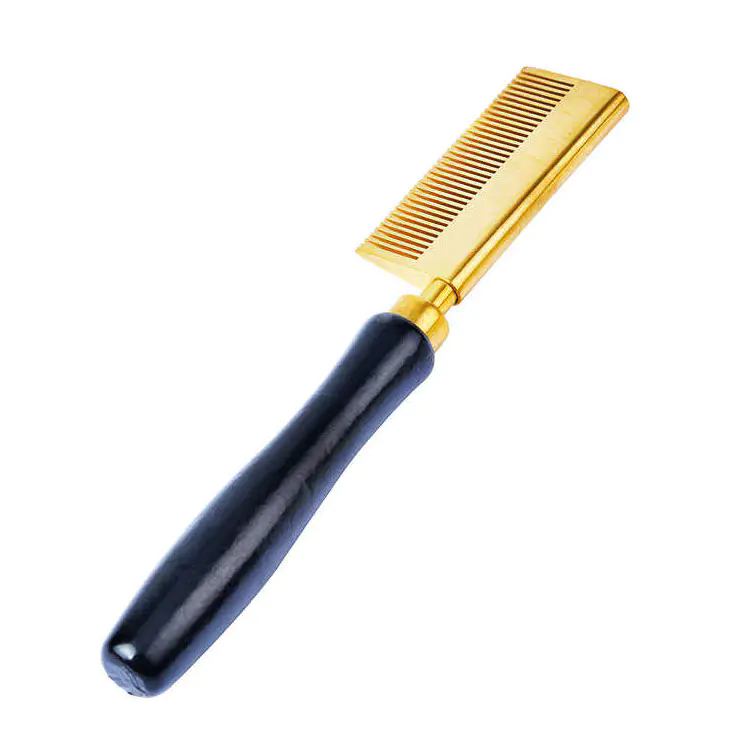
1. What Are the Thermal Properties That Make Brass Suitable for Pressing Combs?
The key thermal properties for a pressing comb are thermal conductivity, specific heat capacity, and thermal diffusivity. Thermal conductivity determines how quickly heat moves through the material. Specific heat capacity determines how much heat energy the material can store. Thermal diffusivity determines how quickly the material responds to changes in temperature. Brass has a thermal conductivity of 120 W/mK, which is 3 times higher than steel and 10 times higher than plastic. This high conductivity allows the heat from the central heating element to spread to the outer teeth quickly. Brass also has a specific heat capacity of 380 J/kgK, which is relatively low, meaning it heats up and cools down quickly. The table below compares the thermal properties of brass with other common comb materials.
| Material | Thermal conductivity (W/mK) | Specific heat capacity (J/kgK) | Thermal diffusivity (mm²/s) | Typical comb application |
| Brass (CuZn37) | 120 | 380 | 36 | Professional pressing comb |
| Aluminum 6061 | 167 | 896 | 69 | Lightweight combs (heats too fast) |
| Stainless steel 304 | 16 | 500 | 4 | Low-cost combs (uneven heat) |
| Ceramic | 1.5 | 880 | 0.7 | Coated combs (slow response) |
| Plastic (PPS) | 0.3 | 1,100 | 0.2 | Cold combs only |
In our factory, we use a brass alloy with a copper content of 63 to 65 percent. This alloy provides the optimal balance of thermal conductivity and mechanical strength. It is also resistant to corrosion and tarnishing, which is important for a tool that is exposed to moisture and hair products. Ningbo Ruishi Technology Co., Ltd. has been manufacturing Pressing Comb Brass components for over 10 years.
2. How Does the Heating Element Layout Affect Temperature Uniformity?
The heating element is the source of heat. If the element is concentrated in the center of the comb, the center will be hotter than the ends. If the element is distributed along the length of the comb, the temperature will be more uniform. The layout of the heating element is therefore critical for even heat distribution. In our factory, we use a distributed heating element that runs the full length of the comb. The element is a resistive wire that is embedded in a ceramic insulator. The wire is wound with variable pitch: denser at the ends and less dense in the center. This compensates for the heat loss at the ends of the comb, where the teeth are exposed to air. The table below shows the effect of element layout on temperature uniformity.
| Heating element layout | Center temperature (°C) | End temperature (°C) | Temperature variation (°C) |
| Center concentrated | 200 | 150 | 50 |
| Uniform winding | 195 | 175 | 20 |
| Variable pitch (our design) | 190 | 185 | 5 |
The variable pitch design reduces the temperature variation from 50°C to 5°C. This means that every tooth of the Pressing Comb Brass is within 5°C of the set temperature. The result is consistent straightening from the first pass to the last. In our factory, we verify the temperature uniformity of every comb design using a thermal imaging camera. The camera captures the temperature profile across the entire comb surface, and we adjust the winding pitch until the variation is within specification.
3. What Role Does the Thermal Interface Between Heater and Brass Play?
The thermal interface is the contact area between the heating element and the brass body. If the contact is poor, the heat transfer is inefficient, and the brass will not reach the set temperature. If the contact is uneven, some areas of the brass will be hotter than others. The thermal interface is managed by a combination of mechanical pressure and thermal interface material. In our factory, we use a high-temperature silicone pad that fills the microscopic gaps between the heater and the brass. The pad has a thermal conductivity of 3 W/mK, which is 10 times higher than air. The table below shows the effect of interface material on heat transfer efficiency.
| Interface material | Thermal conductivity (W/mK) | Contact resistance (cm²K/W) | Heat transfer efficiency |
| Air gap (no interface) | 0.026 | 5.0 | 40% |
| Silicone pad (standard) | 1.5 | 1.0 | 75% |
| Silicone pad (high performance) | 3.0 | 0.5 | 90% |
| Thermal grease | 5.0 | 0.3 | 95% |
We use a high-performance silicone pad with a thermal conductivity of 3 W/mK. The pad is die-cut to match the shape of the heating element and the brass body. It is compressed during assembly to ensure intimate contact. This interface design is one of the reasons our Pressing Comb Brass units achieve 90 percent heat transfer efficiency.
4. How Is Temperature Uniformity Verified in Production?
Temperature uniformity is verified in three stages. The first stage is design verification. We use thermal simulation software to model the heat distribution in the comb. The simulation predicts the temperature at each tooth and identifies any hot or cold spots. The second stage is prototype testing. We build a prototype of the comb and measure the temperature at 10 points along the length using thermocouples. The third stage is production testing. We sample one comb from every production batch and measure the temperature uniformity using a thermal imaging camera. The acceptance criterion is a maximum temperature variation of 5°C across the comb. The table below shows the test results for three production batches.
| Production batch | Center temperature (°C) | End temperature (°C) | Temperature variation (°C) | Acceptance |
| Batch 2026-01 | 190 | 186 | 4 | Pass |
| Batch 2026-02 | 192 | 187 | 5 | Pass |
| Batch 2026-03 | 189 | 184 | 5 | Pass |
| Batch 2026-04 (rejected) | 195 | 178 | 17 | Fail (winding pitch error) |
Quality control note: The rejected batch in the table above was traced to a winding pitch error in the heating element. The element was wound with uniform pitch instead of variable pitch. This error was detected by the thermal imaging test and the batch was reworked. This demonstrates the importance of 100 percent inspection for temperature uniformity.
Frequently Asked Questions About Pressing Comb Brass and Heat Distribution
Summary for Product Development Engineers
Even heat distribution in a Pressing Comb Brass is determined by the thermal properties of the brass, the layout of the heating element, the thermal interface between the heater and the brass, and the thickness of the brass. By selecting the right brass alloy, using a variable pitch heating element, applying a high-performance thermal interface material, and verifying the temperature uniformity with thermal imaging, manufacturers can ensure that every tooth of the comb is within 5°C of the set temperature. This results in consistent straightening and a better user experience. Ningbo Ruishi Technology Co., Ltd. has been manufacturing Pressing Comb Brass components for over 10 years and provides thermal design support for our customers.
Ningbo Ruishi Technology Co., Ltd. manufactures Pressing Comb Brass components with high thermal conductivity, precision winding, and verified temperature uniformity. We provide thermal imaging reports and material certificates for all of our products.