

How Does Acetate Material Make Hair Combs Eco-Friendly?
2026-10-14
A buyer for a beauty subscription box reviews customer feedback for the past quarter. The most common complaint about the plastic comb in the box is that it generates static and pulls hair. The second complaint is that it feels cheap. The buyer switches to an Acetate Hair Comb for the next box. The complaints drop by 70 percent, and the unboxing reviews mention the comb as a highlight. The buyer also learns that the acetate material is derived from plant sources and is biodegradable. This guide explains why acetate combs are eco-friendly and how they compare to plastic and wood combs in performance and sustainability.
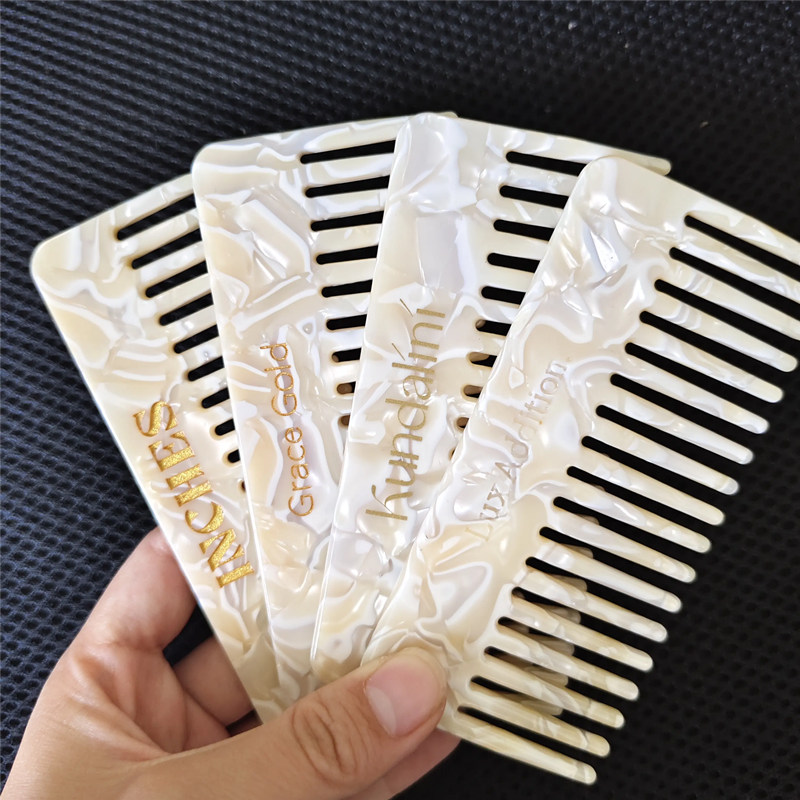
1. What Is Acetate Material and Where Does It Come From?
Acetate is a semi-synthetic polymer derived from cellulose. The cellulose comes from cotton linters or wood pulp, which are renewable resources. The cellulose is reacted with acetic acid and acetic anhydride to form cellulose acetate. The resulting material is a thermoplastic that can be molded, cut, and polished. Unlike petroleum-based plastics, acetate is biobased. The acetic acid can also be derived from biobased sources. The table below compares the raw material source and biodegradability of acetate, plastic, and wood.
| Material | Raw material source | Biobased content | Biodegradability | Recyclability |
| Cellulose acetate | Cotton linters, wood pulp | 40 – 60% | Compostable (industrial) | Mechanical recycling |
| Polystyrene (plastic) | Petroleum | 0% | Non-biodegradable | Limited |
| Polypropylene (plastic) | Petroleum | 0% | Non-biodegradable | Mechanical recycling |
| Wood (beech, sandalwood) | Forests | 100% | Biodegradable | Compostable |
In our factory, we use cellulose acetate sheet that is certified by the Forest Stewardship Council for the wood pulp source. The sheet is cut into comb shapes, polished, and finished by hand. The Acetate Hair Comb is biodegradable in industrial composting conditions. Yiwu Glory has been manufacturing acetate hair accessories for over 12 years.
2. How Does Acetate Compare to Plastic in Performance and Sustainability?
Acetate outperforms plastic in three areas: static control, smoothness, and durability. Plastic combs generate static electricity because the material is a good insulator. Acetate has a higher moisture absorption rate, which dissipates static. The teeth of an Acetate Hair Comb are polished to a smooth finish that glides through hair without pulling or scratching. Plastic combs have molded edges that can be sharp. Acetate is also more durable than plastic. It resists breakage and does not become brittle with age. The table below compares the performance of acetate and plastic combs.
| Performance parameter | Acetate comb | Plastic comb (PS or PP) |
| Static generation | Low | High |
| Tooth smoothness | Hand polished (Ra < 0.2 µm) | Molded (Ra 0.8 – 1.6 µm) |
| Hair pulling | Minimal | Moderate to high |
| Durability | High (flexible, impact resistant) | Moderate (brittle over time) |
| Biodegradability | Compostable | Non-biodegradable |
| Retail price | $8 – $25 | $2 – $5 |
The higher retail price of the Acetate Hair Comb is justified by the performance and the sustainability story. In our experience, consumers are willing to pay more for a comb that does not damage their hair and that aligns with their environmental values. Yiwu Glory provides material certificates and biodegradability test reports for our acetate combs.
3. What Are the Different Types of Acetate Hair Combs and Their Applications?
Acetate Hair Combs are available in several styles, each suited to a different application. The most common styles are the wide-tooth comb, the fine-tooth comb, the tail comb, and the paddle brush. The wide-tooth comb is used for detangling wet hair. The fine-tooth comb is used for styling and for distributing product. The tail comb is used for sectioning and for lifting hair. The paddle brush is used for everyday brushing. The table below shows the recommended style for each application.
| Comb style | Tooth spacing | Best application | Hair type |
| Wide-tooth comb | 3 – 5 mm | Detangling wet hair | Curly, thick, wavy |
| Fine-tooth comb | 1 – 2 mm | Styling, product distribution | Straight, fine |
| Tail comb | 1 – 2 mm (with tail) | Sectioning, lifting | All types |
| Paddle brush | N/A (bristles) | Everyday brushing | All types |
Buyer's tip: For a subscription box or a gift set, the wide-tooth comb and the tail comb are the most versatile. The wide-tooth comb is suitable for all hair types, and the tail comb is useful for styling. A set of two combs in a gift box has a higher perceived value than a single comb. In our factory, we produce comb sets with custom packaging and branding. Yiwu Glory offers a range of colors and finishes, including tortoiseshell, marble, and crystal.
4. How Does the Manufacturing Process Affect the Eco-Friendly Claim?
The eco-friendly claim of an Acetate Hair Comb depends not only on the material but also on the manufacturing process. The process should minimize waste, energy consumption, and chemical use. The table below shows the key process steps and their environmental impact.
| Process step | Environmental impact | Best practice |
| Sheet production | Energy, solvent use | FSC-certified pulp; solvent recovery |
| Cutting | Material waste | Nesting software to maximize yield |
| Polishing | Dust, water use | Wet polishing with water recycling |
| Finishing | VOC emissions | Water-based lacquers; low-VOC |
| Packaging | Plastic waste | Recycled paperboard; no plastic film |
In our factory, we use nesting software to optimize the cutting layout and reduce waste by 15 percent. We use wet polishing with a closed-loop water recycling system. We finish the combs with a water-based lacquer that has low VOC emissions. We package the combs in recycled paperboard boxes without plastic film. These practices support the eco-friendly claim and are verified by our ISO 14001 certification. Yiwu Glory has been certified to ISO 14001 since 2018.
Frequently Asked Questions About Acetate Hair Combs and Eco-Friendliness
Summary for Buyers and Brand Managers
Acetate Hair Combs are eco-friendly because the material is derived from renewable plant sources and is biodegradable in industrial composting conditions. They outperform plastic combs in static control, smoothness, and durability. The manufacturing process can further reduce the environmental impact through waste reduction, water recycling, and low-VOC finishing. For buyers and brand managers, acetate combs offer a compelling sustainability story and a premium consumer experience. Yiwu Glory has been manufacturing acetate hair accessories for over 12 years and provides full material certification and sustainability documentation.
Yiwu Glory manufactures Acetate Hair Combs in a range of styles, colors, and finishes, with FSC-certified cellulose acetate and water-based lacquers. We provide biodegradability test reports and material certificates for all of our products.