
Hair Weft Lifespan: Which Factors Influence Long-Term Wear?
2026-11-19
The lifespan of a Hair Weft depends on more than the quality of the hair itself. Hair origin and processing, cuticle condition, weft construction, installation technique, washing frequency, heat exposure, and everyday handling all influence how long extensions remain attractive and manageable. High-quality human hair may retain its appearance through repeated wear when it is installed correctly and maintained with suitable products, but no extension has a guaranteed lifespan under every condition. The same product can perform differently depending on how often it is worn, styled, washed, and handled.
For salons, distributors, and individual buyers, understanding these factors makes product selection more practical. Qingdao Fly Lum Hair Factory focuses on Remy human hair products with machine-sewn construction and reinforced edges. These features provide a basis for evaluating material and construction, while actual service life still depends on the selected specification and the user's maintenance routine. A realistic assessment should consider the complete product and its intended use rather than relying on a single durability claim.
Which Hair Quality Characteristics Have the Greatest Effect on Long-Term Wear?
The condition of the hair is one of the first factors to consider when evaluating extension durability. Human hair is made up of a cuticle layer, a cortex, and, in some hair types, a central medulla. The cuticle is particularly relevant to the feel and manageability of extension hair. When cuticle layers remain aligned and the hair has been processed carefully, strands are generally less likely to create excessive friction against one another. When the cuticle is heavily damaged or stripped, the lengths may become rough, dry, and more prone to tangling.
Remy human hair is commonly described as hair collected and arranged with the cuticles running in the same direction. This alignment can support a smoother feel and more consistent movement than hair with mixed cuticle directions. However, the term Remy alone does not establish every aspect of product quality. Buyers should also consider the condition of the hair, processing history, sorting standards, and consistency between batches. Chemical treatment, bleaching, colouring, and repeated high-temperature styling can all affect the condition of the hair after purchase.
Another important distinction is the difference between natural hair characteristics and cosmetic finishing. Hair may feel exceptionally soft immediately after production because of conditioning treatments or surface coatings. That initial feel does not necessarily show how the hair will behave after several washing and styling cycles. A more useful evaluation includes checking the hair after cleansing, drying, brushing, and gentle styling. This helps buyers understand whether softness and manageability remain consistent beyond the first impression.
When assessing material quality, our evaluation should cover several practical points:
- Cuticle alignment: Consistent alignment can reduce friction between strands and help limit tangling.
- Processing condition: Excessive bleaching or chemical treatment may weaken the hair and increase dryness.
- Texture consistency: Similar texture throughout a bundle makes styling and blending more predictable.
- Strand condition: Excessive breakage, roughness, or uneven ends may affect the finished appearance.
- Batch consistency: Stable sourcing and sorting practices are important for salons and wholesale buyers placing repeat orders.
Hair thickness also influences how a product looks and feels, but thicker hair is not automatically more durable. Individual strand diameter, density, processing condition, and intended installation all matter. A product selected for a lightweight, natural-looking result may have different characteristics from one chosen for a fuller appearance. Buyers should therefore assess the complete specification instead of using one characteristic as a substitute for overall quality.
At Qingdao Fly Lum Hair Factory, the product range includes Remy human hair options. For professional buyers, our product assessment should begin with the material description and sample condition, followed by an evaluation of how the hair responds to routine care. A sample review is especially useful when the product will be sold under a salon or distributor brand, because the buyer needs to understand both its immediate appearance and its behaviour after normal maintenance.
How Do Weft Construction and Installation Affect Durability?
Even well-selected human hair can develop problems if the construction or installation is unsuitable. A weft is not simply a collection of hair strands; it is an assembled product in which the hair is secured along a seam. The seam, edge finishing, hair distribution, and compatibility with the chosen installation method all influence how the product behaves during wear. Weak construction can lead to shedding or seam-related problems, while incorrect installation can place unnecessary tension on both the extension and the wearer's natural hair.
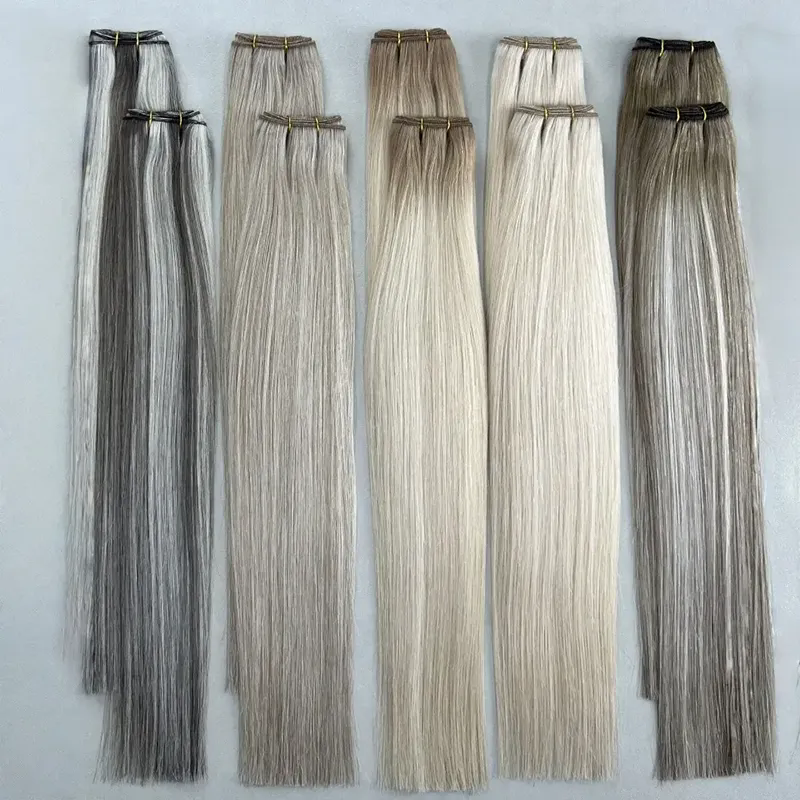
Machine-sewn construction is one method of assembling hair into a consistent weft. It creates a defined seam and can support repeatable production. Reinforced edges are another construction detail worth examining because the edge is handled during installation, adjustment, and maintenance. However, reinforced edges should not be interpreted as a guarantee against shedding or damage. Cutting, pulling, excessive tension, and unsuitable installation procedures can still affect the seam.
The construction method should also match the intended application. A salon professional may select a particular weft type according to the client's natural hair density, desired volume, styling habits, and preferred installation technique. A distributor may place greater emphasis on consistency between batches, available customization, packaging, and product documentation. These are different purchasing priorities, but both require a clear understanding of the actual product structure.
| Product characteristic | Available product information | Relevance to long-term wear |
| Hair material | Remy human hair | Cuticle direction and hair condition influence smoothness, tangling, and manageability. |
| Weft construction | Machine-sewn construction | A defined sewn seam supports consistent assembly and should be handled according to installation guidance. |
| Edge finishing | Reinforced edges | Provides a reinforced edge structure, although careful handling remains necessary. |
| Customization | Weft length and width can be adjusted | Allows product dimensions to be discussed according to application and buyer requirements. |
| Product verification | Sample and specification review | Helps buyers assess material, construction, appearance, and consistency before ordering. |
Installation is equally important. An extension that is attached too tightly may place excessive tension on natural hair and create discomfort. Poorly distributed weight can also make certain sections more difficult to manage. If the attachment is uneven, strands may rub against neighbouring sections or become tangled near the seam. These issues are not necessarily defects in the hair material; they may result from an unsuitable installation method or a mismatch between the product and the wearer's natural hair.
Before installation, our checks should include the condition of the seam, the distribution of hair along the weft, and whether the selected dimensions suit the planned application. The stylist should also assess the wearer's natural hair condition and explain the maintenance schedule. Cutting or modifying a weft should follow the manufacturer's guidance, since the effect of cutting depends on the specific seam construction. Random trimming can compromise the finished edge or increase shedding in some designs.
Qingdao Fly Lum Hair Factory offers machine-sewn products with reinforced edges and customization options for weft dimensions. These details help professional buyers discuss product suitability before ordering. Our factory's production information should be considered alongside a current sample and the exact specification being purchased, rather than assuming that every customized option has identical construction details.
Why Do Washing, Brushing, and Heat Styling Change the Expected Lifespan?
Daily maintenance has a direct influence on how extension hair looks over time. Unlike growing hair, added hair does not receive a continuous supply of natural scalp oils along its lengths. This means that the mid-lengths and ends may become dry more easily, particularly when exposed to frequent washing, strong cleansing products, friction, and heated styling tools. A suitable care routine is therefore not about using as many products as possible. It is about cleaning the hair when necessary, conditioning the lengths appropriately, and avoiding unnecessary mechanical stress.
For many regular wearers, washing every 7 to 14 days can be a reasonable starting point, although the interval should be adjusted according to scalp oil production, exercise, sweat, and styling product buildup. Before washing, gently detangle the lengths from the ends upward. Use lukewarm water and a suitable shampoo, then apply conditioner mainly to the mid-lengths and ends. Avoid rough rubbing, twisting, or piling the hair on top of the head, as these actions can increase tangling.
Brushing should be controlled rather than aggressive. A suitable extension brush or wide-tooth comb can help remove knots, but the technique matters more than the number of strokes. Divide the hair into manageable sections, support the upper part, and work gradually from the ends toward the middle lengths. If a knot does not release easily, separate it gently with the fingers instead of pulling harder. Repeated tension can contribute to breakage and may affect the attachment area.
Heat styling is another factor that can shorten the period during which extensions maintain their original appearance. Straighteners, curling irons, and frequent blow-drying expose the hair to elevated temperatures. Repeated exposure can affect moisture balance and leave the ends feeling rough. Heat protectant may reduce some styling-related stress, but it cannot eliminate damage caused by excessive temperatures or repeated use.
For better day-to-day care, our routine should include the following habits:
- Detangle gently before washing and before going to bed.
- Use a mild shampoo and avoid unnecessary repeated cleansing.
- Apply conditioner to the lengths rather than coating the seam or attachment area.
- Remove excess water with a soft towel without rubbing or wringing.
- Dry the hair and attachment area thoroughly according to professional instructions.
- Use moderate heat and avoid repeatedly styling the same section.
- Secure the hair loosely during sleep to reduce friction against bedding.
- Keep the lengths away from rough clothing, bag straps, and accessories that can catch strands.
Product buildup can be just as troublesome as dryness. Heavy oils, waxes, sprays, and styling creams may accumulate and make strands cling together. Applying more product to solve every tangling issue can create a cycle in which the hair feels coated and becomes harder to cleanse. A small amount of a suitable conditioning product is often more practical than layering several formulas.
Our care recommendations should also account for the installation method. Some maintenance instructions apply to removable extensions, while installed products may require a stylist to clean or inspect the attachment area. A wearer should not assume that every washing or brushing technique is suitable for every construction. Following product-specific and salon aftercare guidance helps reduce avoidable problems and supports more consistent results.
Which Usage and Environmental Factors Should Buyers Consider?
The expected service life of extensions is influenced by how frequently they are worn and the conditions in which they are used. A product worn occasionally for special events experiences a different level of mechanical stress from one used every day. Frequent removal and reinstallation may also create additional handling, while long periods of continuous wear can increase exposure to sweat, styling products, clothing friction, and environmental pollutants.
Climate and daily activities matter as well. High humidity may affect styling and make some textures more difficult to manage. Swimming introduces additional considerations because chlorinated or salt water can leave residues and may contribute to dryness. Sun exposure, wind, dust, and smoke can also affect the appearance of the hair. These conditions do not automatically make an extension unusable, but they may increase the need for appropriate cleansing and conditioning.
Buyers should distinguish between the lifespan of the hair material and the service interval of an installed extension. The hair itself may remain usable after an installation needs professional adjustment or removal. Conversely, a product may need replacement because of tangling, shedding, breakage, or loss of manageability even if the attachment remains secure. These are separate issues and should not be combined into one universal lifespan estimate.
For salons and distributors, our product review process should consider the following questions:
- Is the hair material clearly identified and supported by a product specification?
- Does the sample maintain acceptable manageability after washing and drying?
- Is the seam construction suitable for the intended installation method?
- Are the available dimensions appropriate for the target customer group?
- Can the supplier provide consistent product details for repeat orders?
- Are care instructions available for salon professionals and end users?
Qingdao Fly Lum Hair Factory has more than 23 years of production and export experience according to its company information. For buyers evaluating a long-term supply relationship, our purchasing process should include sample assessment, confirmation of the selected specifications, and clear communication about customization. These steps are more useful than relying on a broad claim that a product will last for a fixed number of months or years.
Before placing a wholesale order, buyers should confirm the available hair lengths, weights, colours, textures, packaging, minimum order quantity, and lead time for the selected specification. These details should be checked against the current product offer because customized orders may differ. A sample also allows the buyer to assess colour, texture, seam appearance, and handling before committing to a larger quantity.
Ultimately, long-term wear is a shared result of product quality, construction, installation, and aftercare. No single feature can compensate for unsuitable handling or poor maintenance. A transparent specification and realistic care guidance give salons and distributors a stronger basis for setting customer expectations and reducing avoidable complaints.
How Can Buyers Make a More Informed Product Decision?
When comparing suppliers, it is useful to move beyond appearance and ask for details that can be checked. Buyers should request a sample, review the material description, inspect the seam, and confirm which customization options are available. They should also ask whether the supplier can provide consistent specifications across repeat orders. These checks help distinguish a clearly documented product from one described mainly through broad marketing language.
Our approach to supplier evaluation should include both technical and commercial considerations. Technical checks cover hair material, construction, edge finishing, dimensions, and care guidance. Commercial checks include order quantities, sample arrangements, customization, packaging, and production lead times. The information should be confirmed for the specific product rather than assumed to apply to every item in a supplier's range.
It is also important to understand what a supplier can and cannot guarantee. A manufacturer can describe its materials and production methods, but the actual wearing period depends on installation, frequency of use, styling habits, and maintenance. Buyers should be cautious of fixed lifespan promises that are not supported by defined testing conditions. A more credible product discussion explains the construction, identifies relevant care requirements, and makes clear which specifications can be confirmed.
For professional buyers considering customized Remy human hair products, Qingdao Fly Lum Hair Factory provides a starting point for discussing machine-sewn construction, reinforced edges, and adjustable weft dimensions. Contact our team to request current product details, discuss your intended application, and arrange a sample review before confirming a wholesale order.
Frequently Asked Questions
1. How long can human hair weft extensions last with proper care?
There is no universal lifespan because wear depends on hair quality, processing history, installation method, washing frequency, heat styling, and daily handling. Extensions used occasionally may remain presentable longer than products worn and styled every day. Buyers should assess the actual hair condition and construction, follow the manufacturer's care instructions, and have installed extensions checked by a qualified stylist when necessary.
2. Does machine-sewn construction make extensions more durable?
Machine-sewn construction creates a defined seam and supports consistent assembly, while reinforced edges provide additional structure along the weft. These features can be relevant when evaluating product construction, but they do not guarantee a specific wearing period. Installation tension, cutting methods, handling, and maintenance still affect shedding, seam condition, and overall performance.
3. What are the most common reasons extensions become dry, tangled, or difficult to manage?
Common causes include excessive washing, harsh cleansing products, product buildup, repeated high-temperature styling, friction during sleep, and rough brushing. Hair that has undergone substantial chemical processing may also be more vulnerable to dryness and breakage. Gentle detangling, suitable conditioning, moderate heat use, and regular inspection can help reduce avoidable wear.